



|
Plating
Plating usually
describes a process of metal finishing that deposits a metallic
coating onto some form of substrate. Plating is done to protect, beautify,
increase corrosion or wear resistance, affect conductivity of heat or
electricity and or solderability of an item. For our purposes, plating can
be generally described by two different processes, electroplating and
electroless deposition. Electroless
plating involves the use of an aqueous solution containing metallic ions that is
designed to deposit the metal onto a substrate through autocatalytic reduction
of the metallic ions in the solution.
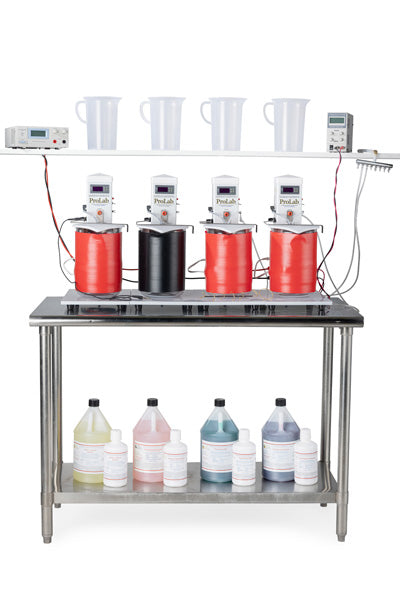
Electroplating is a process where a metal in solution is deposited onto an
electrode that is negatively charged relative to the solution. The item being
plated can be referred to as the cathode. The solution is charged through
the use of an anode. Since the metal in solution is in ionic form
and contains a positive charge, it migrates toward the negatively charged
cathode. Once the metallic ion has reached the cathode it picks up the
electrons and is deposited onto the cathode (item being plated). The
metallic coating accumulates one atom at at time. Faraday's law states
that for each Faraday of electricity (96,5000 Coulombs of
electrons), one gram of metal will be deposited on the cathode. The
plating industry uses amperes as the measure of current flowing through the
system. One Ampere = 1 Coulomb of electrons for 1 second therefore it is
possible to determine the amount of metal deposited onto the cathode by
factoring the amperes by the amount of time the current is flowing.
It is important to note that the
actual amount of metal deposited by the system is a product of time, the total
current flowing through the solution, and bath efficiency; also called the
cathode efficiency. Since bath efficiency can range from less than 10% to
more than 90%, it is important to understand the chemistry of the bath to
monitor it's efficiency. For example the metallic content affects the
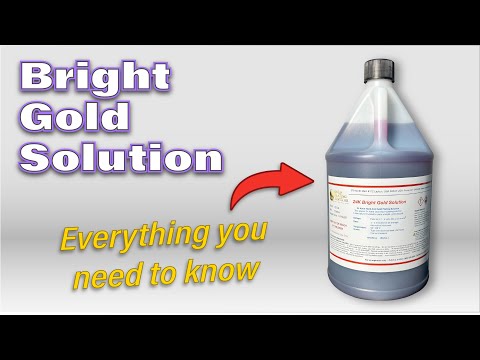
cathode efficiency of our
24K Bright Gold Solution near the
range of the stock solution we provide. Due to cost factors we typically
offer this solution with approximately one-half Troy oz fine gold per gallon,
(3.91g/qt.). The
depletion table for this solution indicates that increasing the gold content
above this level has little effect on the bath efficiency. However, as
gold is depleted from this solution the bath efficiency can fall off
significantly.
There are many factors that
affect the properties of the deposit. A few of the main factors are;
Current density, which is the ratio of the system amperage over the unit area of
the anode or cathode. The temperature of the solution. The pH
of the solution. The concentration of metallic ions. Relative
movement of the solution and cathode.
In the future we will be building on the information base on this subject.
We plan to have hyperlinks from various key-words in this section to other
sections for more detail. Please Check Back Again Soon!
Back to Fundamentals of Plating Index

Plating
With Gold
General Physical Properties of Gold
| Atomic Number: |
79 |
| Atomic Weight: |
196.97 |
| Density: |
19.3 grams per cubic
centimeter |
| Melting Point: |
1063 C |
| Boiling Point: |
2970 C |
| Thermal Conductivity: |
0.71 cgs units(20 C |
| Chemically Resistant to: |
Sulfuric acid (100 C),
fuming sulfuric acid, persulfuric acid, fuming nitric acid, 30% hydrochloric
acid, perchloric acid, hydriodic acid, phosphoric acid, acetic acid,
tartaric acid, citric acid, selenic acid |
| Chemically Attacked by: |
Sodium and potassium
cyanide plus oxygen, aqua regia, chlorine, chlorine water, bromine and
iodine in alcohol, selenic acid (+230C) |
Because of its unique physical
properties and lasting beautiful color gold has always been one of mans
favorite elements. Since the beginning of recorded history gold has served as an
art medium and a symbol for wealth, eternity, the Sun, life, love and many other
desirable parts of the human experience. Aside from the psychological,
metaphysical, and religious appeal of gold it has certain physical properties
that make it a desired medium. From the ancient goldsmith to todays scientist,
gold is unique in is use.
The process of electroplating gold
onto properly prepared conductive surfaces
electrochemically deposits a very thin1 layer of metallic gold over
the surface of the item to be plated. This process can impart some of the
desired properties of the gold to the entire piece being plated at a fraction of
the cost of solid gold. In many cases you can maintain the important
mechanical properties of the substrate and obtain the desirable benefit of an
exposed gold surface. An example of this is gold plating stainless steel
or copper electrodes for the fuel cell industry. In this case you can have
the strength or conductive properties of the substrate and the corrosion
resistance and/or catalytic, conductive or chemical effect of the gold surface.
1
For a hardened gold plate, (Type I & II - Grade B, C or D), the gold layer
typically ranges in thickness from 5 micro-inches, (0.125m), to 100
micro-inches, (2.55m). Hard gold plate deposit thicknesses greater than
100 micro-inches can result in deposit stresses that may be detrimental to the
value of the gold plating. Pure soft gold, (Type III, Grade A), Can be
plated much thicker. We commonly plate Type III gold to a thicknesses
greater than 500 micro-inches, (12.55m). The trade off is that the grain
structure is more course which allows greater diffusion and generally makes the
surface more "matt" in appearance.
The density of 24K gold
plating
is ~ 12.45mg/in2/5m, (~0.00004 inches) thickness.
Therefore, if evenly distributed, 1 gram of 24K gold will plate approximately
160 square inches of area to a thickness of 1/2 5m, (0.00002" or 20
micro-inches). This thickness is the minimum thickness of gold plating for
jewelry items to be sold as "gold plated" in the United States under the US
Federal Trade Commission standards. Note: The density of gold plating can range
from 11.3mg/in2/5m through 12.45mg/in2/5m the upper end of the range is for a
very fine grain gold plate.
Units for the thickness of
gold plate are normally stated in
English
terms of "micro-inches", (millionths of an inch, i.e. 1 micro-inch =
0.000001") or when
Metric terms are preferred then "microns", (also know as "5m" -
"micro-meters" i.e. 15m = 0.000001 meter ), are used. In discussing the
thickness of gold plate the term "micron" is frequently used when
"micro-inch" is the intended unit of measure. This can create a
discrepancy since a micron is about 40 times greater than a micro-inch.
Less frequently the term "mil" is used when
"micro-inch" is intended, this can be a much bigger problem since there are 1000
micro-inches in a mil. One example of such a problem was recently noticed
when a seller at a popular on-line auction was offering 20 gold plated pennies
for $4.95. This is a good deal but
then they went on to say
"Each coin is specially layered with 7 mils
of Genuine Pure 24 Karat Gold". Using the
density information above and a little arithmetic* shows that this
seller is offering 1.25 troy ounces of gold for $4.95. This is not likely
since as of this writing the London bullion market is at $1,875.00/troy oz.
*A one mil thickness of
24K gold plate will weight 0.316 grams per square inch. The surface area
of a US penny is ~0.88 square inches. Therefore - 20pennies * 0.88 in2/penny
* 0.316 grams 24K gold/in2/mil thickness * 7mil thickness = 38.93
grams 24K gold.
For gold plating trivia and interesting facts visit
this page
What is
MIL spec Plating? At Gold
Plating Services we provide metal finishing and gold plating for many different
customers for many different reasons. Many of our customers want
decorative gold plating and rely on our expertise to provide them with a type
and thickness of gold plating that will best fit their purposes and budgets.
We have the experience and expertise to advise them on their options.
Other clients use standard specifications that define many important aspects of
the plating process. For those who aren't sure of exactly what will work
best for them we may suggest a specification process that will define the
results they need. We specialize in plating a 24Karat gold to a specific
MIL-Spec. (MIL-G-45204-C - recently superseded by
MIL-DTL-45204D see below).
Plating gold to these specifications insure that the final product will meet
strict purity, thickness, and hardness standards. These specifications also
mandate other factors such as undercoating, adhesion and solderability. The
specifications also references other MIL and ASTM standards and verification
tests. We apply Mil-Spec plating to items for the aircraft, medical
instrumentation industry, and electronics industry. In some cases we are
applying a 24K gold plate to various grades of stainless steel and in others, we
are plating onto copper, aluminum or brass alloys.
New
MIL-DTL-45204D Gold Plating Specification.
The U.S. Army Research Laboratory has developed a new specification that
supersedes the MIL-G-45204C, (dated 7 June 1983), specification referenced
above. The new specification is MIL-DTL-45204D, (dated 29 June 2007), is
24 years more current and addresses questions not adequately covered by the old
specification. The classifications by Type, Grade,
Purity vs. hardness, and Class are similar to the old spec, however
the new specification includes standardization references to non-governmental
and international, (ISO), agreements. The new specification also has
expanded quality control, testing and packaging procedures. We have this
document available as a PDF file for $25.00. Payment can be made by PayPal
or major credit card by e-mail or phone. We will e-mail the document
immediately upon receipt of payment. For more details click this link -
Purchase MIL-DTL-45204D include payment in formation in the e-mail. We
will e-mail a receipt and attach the specification. Or you can call (801)
546-6200.
In the future we will be building on the
information base on this subject. We plan to have hyperlinks from various
key-words in this section to other sections for more detail. Please Check
Back Again Soon!
Back to Fundamentals of Plating Index

Plating Onto Common Metals
We will be continuously adding
to this information base on methods of metal finishing and plating onto
different types of substrate. In our gold plating business we plate onto
many different types of metal surfaces. One of our clients has us gold
plate coins struck in different substrates. A good example of the type of gold
plated coins is the 2000 Presidential Election Coin.
These coins are struck in a bronze copper alloy. When plating gold onto
any copper alloy, such as bronze, we normally plate with a bright nickel prior
to gold plating the coin. There are two reasons for this
nickel plate. One reason is to provide a diffusion barrier between the
copper alloy and the gold plated coin. This is important because over
time, copper can corrode and diffuse through the gold, changing the appearance
of the gold. The second reason for the nickel plate is to enhance the
brightness of the finish. A mirror bright nickel plate will give a high
level of luster to the gold plated finish. We also do selective gold
plating onto coins. When doing selective gold plating onto coins, (or
anything else for that matter), we usually mask the area that we don't want to
gold plate and then gold plate the coin normally. The trick in doing
selective gold plating coins is to apply the mask in a manner that provides as
much detail as possible. An example of selective gold plating on a coin is shown on our Golden
Gifts Trading Post. Selective gold plating onto coins has been very
popular with the U.S. Mint's State Quarters program. We are working with a
major mint who has developed an oversized States Quarters. We are offering
these gold plated, State Quarter replicas on our
Golden Gifts Trading Post. They are available in two grades. A
bright un-circulated-circulated, 24K gold plated or German silver (nickel) or LE
Proof. Limited Edition Proof. The "LE Proofs" are double struck in 1
oz .999 sliver and are also available in a 24K gold plate.

Scientific, Technical and Special Purpose Gold Plating
|
Is gold plating right for your project?
We get a large
number of inquires relating to the applicability of gold plating for
many different purposes. The gold plating services we provide fall
into three general categories. The type of plating process we use
depends on the customer's specific requirements.
Many times the customer requirements are a combination of the
following types of plating.
If you are
wondering if gold plating may be right for your needs you may want to
refer to the information that follows chronicling clients we serve that
have special needs. If you
need more information on the properties of different types of gold plate
please feel free to e-mail our technical department with your questions.
terry@goldplating.com
1.
Decorative
A large
number of inquires for gold plating we receive are for
decorative purposes. While
there are other metals that have the same general appearance as gold,
they usually dont offer the same corrosion resistance and combination
of physical properties as gold plating.
Gold plating is also very economical as a decorative finish when
compared to the other options.
This is especially true when you consider that much of the cost of
providing a decorative electroplated finish is incurred in the
preparation of the surface prior to the final finish.
An excellent example of this is in jewelry restoration.
The antique copper bracelet we restored, (
http://www.goldplating.com/Bracelet.htm
), required hours of
tedious labor to prepare the bracelet for plating, this is where most of
the cost was incurred. The
actual value of the gold we applied was just a few dollars.
However, as far as the owner was concerned it turned a piece of
useless jewelry into a valuable heirloom that will be passed on for
generations. Generally
speaking, the cost of decorative gold plating is ranges from $2.00 -
$3.00 per square inch (.25m to .55m thick).
This would not include any unusual finishing, restoration, special
handling or pretreatment.
Of course the price also is dependant on other factors such as quantity,
size and special tooling that may be required.
Many people are rightly concerned about the softness of 24K
gold for decorative applications.
We recognize the limitations of all electrodeposited finishes and strive
to give the customer the best information possible for making a choice
that is the most suitable for their purposes.
There have been many times when we have indicated that gold
plating is not appropriate for a particular purpose and have helped the
customer decide on a different choice.
For decorative gold applications, we normally recommend a cobalt
hardened 24 karat gold.
This gold is a 99.7% pure gold, is extremely corrosion resistant, and is
about three times as hard as the pure gold we use for medical,
electronic and other applications where hardness isnt required and
purity of deposit is.
2.
Corrosion resistance
Because of the relative low cost and high resistance to many
corrosive environments, we provide a great deal of gold plating that has
the primary purpose of providing corrosion resistance to a substrate
that otherwise would quickly corrode, such as copper.
This need arises quite often because the desirable electrical
properties of copper is quickly diminished by the reactive nature of the
copper surface. While gold
is not as conductive as most copper
or silver, gold does provide much better resistance to corrosion
than either metal. Hence,
we often provide a gold plate over a copper or silver substrate.
An excellent example of using gold plating as a corrosion
resistant barrier for a copper substrate is found on our home page.
The RF load coil shown is a key component of an inductively
coupled plasma mass spectrometer, (ICP-MS).
These coils operate in an extremely harsh environment under high
temperatures, and have to withstand high frequency electrical current
without significant degradation of the surface.
The scientist who developed, and patented these high performance,
corrosion resistant coils had tried different combinations of transition
elements before settling on this particular process which involves
the application of an extremely heavy pure gold electroplate over
a copper substrate with a transition element diffusion barrier.
For a better look at these coils and a more information on their
performance specifications you can visit http://www.noblecoil.com/.
Even a bright, hard gold plate is somewhat porous; therefore when
the gold is applied over a substrate that poses the possibility of
diffusing through the gold, such as silver or a copper alloy, we
normally suggest a transition element diffusion barrier such as
nickel, rhodium or palladium.
This will help insure that the substrate is protected against the
environment. We provide
gold plating services for some high-energy research laboratories that
specify the deposit must not be magnetic.
Since most nickel deposits are magnetic to varying degrees this
precludes the use of nickel as a diffusion barrier.
In this case we usually recommend increasing the thickness of the
gold plate to a level that prevents significant diffusion under most
conditions, (25m is generally sufficient), or using a platinum group
element such as rhodium or palladium. The new MIL-DTL-45204D references gold plating as a chemical agent
resistant coating, (CARC).
3.
To provide physical properties unique to gold such as reflectivity
or conductivity.
We have many research and development labs contact us about gold
plating for their projects because of some of the other known properties
of gold plating. One such
contact was a company developing a medical laser.
The gold plating they required was for excellent reflection throughout
the electromagnetic spectrum from visible through near-IR (e.g. up to
820nm and specifically 808nm, the most important wavelength for Nd:YAG
lasers).
They indicated measurements on our plating in excess of 97%
reflection throughout this spectrum.
Since they were looking for a reflector that works in the 808nm
range, gold was the perfect choice for their project.
The reflectors were a 316 stainless steel, we provided 15m of
hardened gold applied directly to the polished stainless steel surface.
We have another client that produces equipment that utilizes a
component that operates in such a harsh environment that nothing they
had tried would prevent the item from literally burning up in just a few
hours. Our technical staff
worked with their development engineers to find a solution that utilized
a pure nickel substrate followed by a heavy (25m+) pure rhodium plate
with 55m of a 999+% gold deposit.
The components produced utilizing this very specialized process
have preformed for months of extreme, continuous testing.
4. Gold Plating
Stainless Steel items with or without a nickel underplate?
We specialize in gold plating onto stainless steel items for a variety
of technical and decorative purposes. The question of using a
nickel underplate when plating gold onto stainless steel frequently
comes up. Here is an opinion letter regarding nickel underplate
for stainless steel that was written by one of our technical advisors.
Nickel Underplate When Gold Plating Stainless
Steel
Because of its inert chemical properties, versatility of
application and relatively low cost, electroplating of gold has proven
to be the answer to many engineering and technical problems.
|
|
Frequently Asked Questions
(Q)
..
Is it really possible to
make money with a portable gold plating business?
(A)
..
Absolutely, we have many customers that started their portable gold
plating business on a part time basis with little more than a cell phone
and the components that initially came in their original electroplating
kit. With a service oriented attitude and some persistent work,
they have grown it into an excellent income. Others have kept is
as a part time "extra income" business only plating a few cars a month.
Because there is virtually no fixed overhead, it works perfectly as a
part time business. Follow this link for
more information on making money with a gold plating business.
(Q)
..
I work in an auto auction & am in a parking
lot every day & inspecting emblems. I honestly don't know a gold plated
emblem from a gold colored plastic yet. I've seen several that are
darkened and others that look as if they have black bubbles through out.
Would these be simply plastic or poorly applied gold?
(A)
..
Probably both. Most automotive emblems are plastic and most of the
emblems that look gold, (in good or bad condition), are plastic emblems
that have been gold plated. The reason that the bad looking gold
looks bad is most likely the result of being plated with a "short cut"
method of gold plating or they were plated by someone that wasn't
concerned about the quality of their work. We are trying to head
off this image in our industry by promoting high quality workmanship,
not just going for the fast buck now. We do this by only promoting
the most durable process of automotive gold plating, i.e. chrome removal
and applying the gold heavy enough to insure corrosion protection to the
underlying nickel. Any gold plated layer is relatively thin and
somewhat porous. If the gold layer isn't thick enough to seal off
the underlying nickel plate then corrosive environmental conditions can
corrode the nickel plate. When the nickel plate corrodes, it first
forms tiny black pits. The black pits develop into small mounds
that look something like a miniature volcano when magnified. These
mounds are caused by the corroded nickel expanding under the surface.
From a distance this nickel corrosion can appear as a general
darkening of the emblem. When the nickel gets to this point, the
emblem most likely needs to be re-plated with nickel and is probably not
worth saving. At Gold Plating Services, we have always offered a
lifetime warranty on our automotive gold plating. We guarantee
that the gold we apply plate won't peel, flake, or corrode for the life
of the car. We promote a process that allows this type of
warranty. By the way, there are a few vinyl automotive "emblems"
(I call them decals) that are suppose to look like gold, they are soft
and will indent if you push on them with your thumbnail.
(Q)
.. I've heard that the thickener
used to convert liquid brush plating gold to a gel reduces the amount of actual
gold solution I receive by up to 1/3. Does your gold thickener add to the volume
of gold?
(A)
.. NO, the thickener we use is
a very fine powder. The amount required to thicken an 8oz jar of gold actually
increases the total volume of the solution by less than 2%. We compensate for
the added volume by slightly overfilling the jar. When you buy the solution you
are actually buying the pre-thickened volume. We do, however have some customers
that prefer to buy the solution as a liquid and the thickener on the side. They
then add the thickener to suit their personal preference.
(Q)
.. Why is aluminum so difficult to plate?
(A)
..
Aluminum is a very reactive metal.
After being polished or cleaned the surface oxidizes within seconds of coming
into contact with the air. The resulting thin layer of aluminum oxide is very
inert, coherent, and protective and cannot be reduced (returned to the
pre-oxidized state) electrolytically. The oxide layer cannot be plated onto. One
typical method used to plate onto aluminum involves removing the oxide layer
using a strong alkaline solution which simultaneously replaces the oxide film
with a layer of zinc (known as zincating). The zincated part can then be plated
with an electroless nickel or alkaline copper solution. The part can then be
plated normally. The use of the extremely caustic zincate solution and hot dip
electroless nickel solution makes plating onto aluminum impractical for most
portable platers using standard electroplating kits. Many larger chrome shops
can economically plate a heavy coat of hot-dip decorative nickel onto aluminum.
This will produce a very hard mirror bright surface that then easily be gold
plated. While it is possible to plate onto aluminum using a portable system, the
process is not cost effective and the durability of the resulting finish is
generally not sufficient for long term service. When we have a customer that
wants an aluminum part gold plated we always recommend a procedure that involves
a hot-dip nickel layer.
(Q)
..
Would your machines work to repair chrome for hotrod/muscle car enthusiasts?
Would the pieces need to be completely stripped down or could chrome be
applied in these scratched/"injured" areas?
(A)
.. Our system will repair chrome as well
or better than any portable system on the market. However, I like to give
people an honest answer to the chrome repair question. You need to
understand that chrome is normally plated over a heavy, hot dip immersion nickel
that produces a lot of thickness relative to the chrome plate. The heavy
nickel plate is plated over a heavy copper plate. Therefore, offering a
"chrome plate repair" without being able to also repair the underlying copper
and nickel is a little like trying to fix a dent in a fender by simply applying
a thin layer of paint. While it is possible to sand out the ding, plate
with copper, polish, plate with nickel, polish and then plate with chrome this
repair would require a lot of time and a high level of craftsmanship, and almost
never would be worth the effort. This is especially true in light of the
fact that a large chrome shop will straighten, strip and completely re-plate an
entire bumper for a couple of hundred dollars. There are well established,
large chrome plating businesses that have invested millions of dollars in chrome
plating equipment. These companies such as
Ogden Chrome Plating, provide an extremely high level of service for a
relatively low price. It is our opinion that it is not smart for a person
with a portable plating system or a home based (bucket) chrome plating system to
compete with these well established companies. This is epically true when
the environmental regulations and procedures for disposal of rinse water and
spent solutions is taken into account. There are far more profitable
ways to utilize a portable gold plating system. In fact, I have never
heard of anyone that has made a profit offering portable automotive chrome
repair.
(Q)
.. How can I tell if a conductive surface is
chrome, aluminum, or stainless steel?
(A)
.. Most silver colored, metallic (conductive),
surfaces encountered in everyday use are either chrome, stainless steel,
aluminum, nickel, zinc or silver.
If you are faced with a surface and don't know what it is. By using our portable
plating system, you can determine which of the above four it is by grounding the
part and touching the surface with your chrome stripping wand. If it is chrome
plated there will be a distinct yellowing of the chrome stripping solution.
Careful analysis of the surface after you have worked on it with the chrome wand
will reveal a slightly darker, bright metallic surface, (the nickel) as opposed
to the chrome that has more of a blue tint. If the item is stainless steel, you
should be able to detect some light, bubbling action where the wand is in
contact with the surface. The stripping process won't have any affect on the
appearance of the surface, however the solution may develop a light purple tint.
An aluminum part may initially react like stainless steel. The chrome stripping
solution will lightly attack the surface of the aluminum, when you have moved
the wand away from the surface there may still be some light bubbling where the
solution was left on the part. After rinsing, the area that you tried to strip
may be slightly milky white and with less luster. Normal polishing with metal
polish will return the surface to its previous condition. Since polishing may be
required on aluminum items, it is recommended that you try a very small area on
items that could be aluminum. Silver surfaces will immediately turn black when
you try to strip them with the chrome stripper. Don't worry, the nickel
activator will remove the smut. Zinc parts won't have any reaction to the
stripper, but the nickel activator will attack the zinc surface even without
having the common applied. If you then try to gold plate a zinc part using our
normal gold solution, the part will turn black.
(Q)
.. Why do I need to use a nickel strike on stainless steel?
(A)
..
Stainless steel, is a family of steel alloys that contain, among other
things, 15% to 20% chromium. The chromium is a little like
aluminum in that it forms a thin, self-healing layer of chromium oxide.
The chromium oxide is inert and therefore highly corrosion resistant and
difficult to plate onto. Fortunately, unlike aluminum oxide, the
chromium oxide can be chemically reduced using an acid solution. If the
acid solution contains nickel, such as the Woods Nickel Strike that
comes in our electroplating kits, the reduced chrome can then be
simultaneously plated with the nickel in the strike. The part can then
be activated and plated normally. Remember that a key step in our
stainless procedure is to abrasively remove the all of the oxide layer
possible prior to the nickel strike step. Since we have had so many
questions on the stainless procedure, I have revisited our published
stainless procedure and amended it. I have taken out the nickel prep
step, which is only necessary under extremely oily conditions.
Click here for the stainless steel procedure
(Q)
.. Does an automobile emblem have to be removed before it
can be gold plated.
(A)
..
Not usually, our electroplating kit utilizes a
unique process has been developed to allow the technician to leave the emblem on
the car in almost every case. The plating solutions will not affect most new car
finishes. Our training will teach you how you can tell if there could be a risk
of having a problem with leaving an emblem on the vehicle. Being able to leave
the emblems on the vehicle provides a great advantage for the on-site plater.
Imagine the cost of removing the emblems, sending them to a plating company and
then having to re-install the plated emblems, and then having to re-install the
plated emblems.
You can see exactly how an emblem is plated while on the car by following this
link. 
(Q)
.. How long will the gold last ?
(A)
.. 24 Karat gold will never
corrode under normal conditions. The plating that is applied with our
system is the same as any other 24 karat gold electroplate, no more or less.
While 24 Karat gold will never corrode under normal conditions and if applied
correctly should never peel, flake or fade it is very soft and needs to have
proper care to insure maximum life.
Selected
E-mail questions from our site visitors
|
Back to
Fundamentals of Plating Index
|