


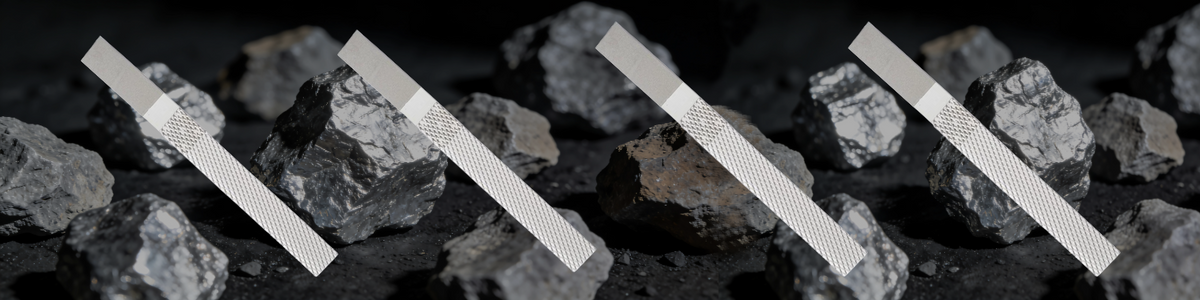
Lab Anodes & Custom Platinize Electrode Material
We keep 5 standard lab anode options in stock and ready to ship, along with custom-fabricated anodes designed to fit our Jewel Master Pro Series, Prolab CM, and Universal Dip Kit. Every custom piece is built to exact specifications to properly fit your equipment and beakers.
Custom Anode Stock
In addition to our platinum-coated substrates, we offer custom-cut anodes in the following materials:
- Nickel (Bagged): 0.062" thick x 1" wide, available in lengths up to 24"
- Copper: 0.0625" thick x 1" wide, available in lengths up to 24"
- Type 316 Stainless Steel: 0.036" thick x 1" wide, available in lengths up to 24”
Need a Custom Quote?
Email your preferred material and dimensional specifications to orders@goldplating.com for pricing.
In-Stock Standard Platinized Titanium Anode
Our ready-to-ship Platinized Titanium Anode is a non-consumable, inert anode built for maximum reliability and long-term performance. While it requires a higher upfront investment than alternative anode materials, it offers unmatched durability and consistent results for everyday plating. Because it resists dissolving into your bath, it can be safely used with virtually any plating solution (excluding hydrofluoric acid) and is most commonly paired with our 24K Pure Gold Solutions and TriVal Gold Strike Activator or Stainless Steel.
-
Mesh Dimensions: 6" long x 1" wide x 0.060" thick expanded titanium mesh

- Plating: 100 micro-inches of pure platinum
- Tab: 3" unplated titanium tab (0.040" thick)
- Compatibility: Safe for nearly all plating baths; ideal for 24K Pure Gold and TriVal Gold Strike solutions
- Performance: Higher upfront cost, but delivers the best long-term reliability and service life
Electrode Materials & Custom Fabrication
We manufacture custom-shaped electrodes, frames, and hanging tabs to match your exact specifications. Choose between two high-performance substrates depending on your plating setup:
1. Platinum-Plated Expanded Titanium

Produced by electroplating pure platinum onto an expanded, flattened titanium substrate (available in 0.035" and 0.060" thicknesses). For custom shapes, we fabricate the titanium first and then electroplate it to your required thickness.
- How it performs: Because electroplated platinum is naturally porous, your plating solution will contact the titanium base. While this can anodize the titanium, the outer platinum coating maintains steady electrical conductivity with the solution.
- Important Warning: Do not use platinum-plated titanium electrodes in solutions that dissolve titanium, such as hydrofluoric acid.
2. Platinum-Clad Niobium

Manufactured from a solid niobium sheet mechanically clad with pure platinum (125 or 250 micro-inches thick) on one or both sides, then expanded into a mesh slightly stiffer than an aluminum window screen.
- How it performs: Expanding the sheet leaves the inside edges of the mesh openings exposed, which may anodize in certain solutions. However, the liquid-tight bond between the platinum cladding and the niobium maintains strong electrical "throwing power."
- Key Benefits: Niobium is more conductive than titanium and is less likely to be affected by harsh solutions beneath the cladding. Because it is less rigid than 0.030" expanded titanium, it typically requires a support frame to hold its shape.
- Ordering Tip: Platinum-clad niobium is produced in 6"-wide strips. For the most cost-effective custom pricing, order in 6" widths with lengths in 6" increments.
Need a Custom Quote?
Email your preferred material and dimensional specifications to orders@goldplating.com for pricing. (Please note: Custom fabrication begins once payment is received and drawings are approved, with a standard 4–6 week lead time.)
Setup & Usage Guide
The following setups work with any of our standard or custom anode stock.
Single Solution Electrode Setup

Ideal for standard beaker plating (such as 24K Pure Gold Plating solution). For best results, match the surface area of your anode to the surface area of the item being plated (the cathode).
- Connections: Attach the Black lead (-) to the item being plated (cathode) and the Red lead (+) to the anode.
- Best Practice: Rotate the piece occasionally during plating. Deposition rates are naturally higher on the side facing the anode and lower on the opposite side.
Multiple Solution Electrodes Setup

For larger or complex pieces, arrange a group of four Platinum-Plated Lab Anodes in a circle inside your beaker, secured in place with a 1/8" polyethylene strip.
- Best Practice: A circular layout creates a much more consistent "throw" and even plating coverage across the entire surface compared to a single electrode.
- Solution Purity Note: Preventing metal contamination is critical in electroplating. Titanium is highly inert and safe for most solutions. Even if the porous platinum allows the solution to touch and anodize the titanium underneath, the platinum layer keeps your current flowing without contaminating your bath.